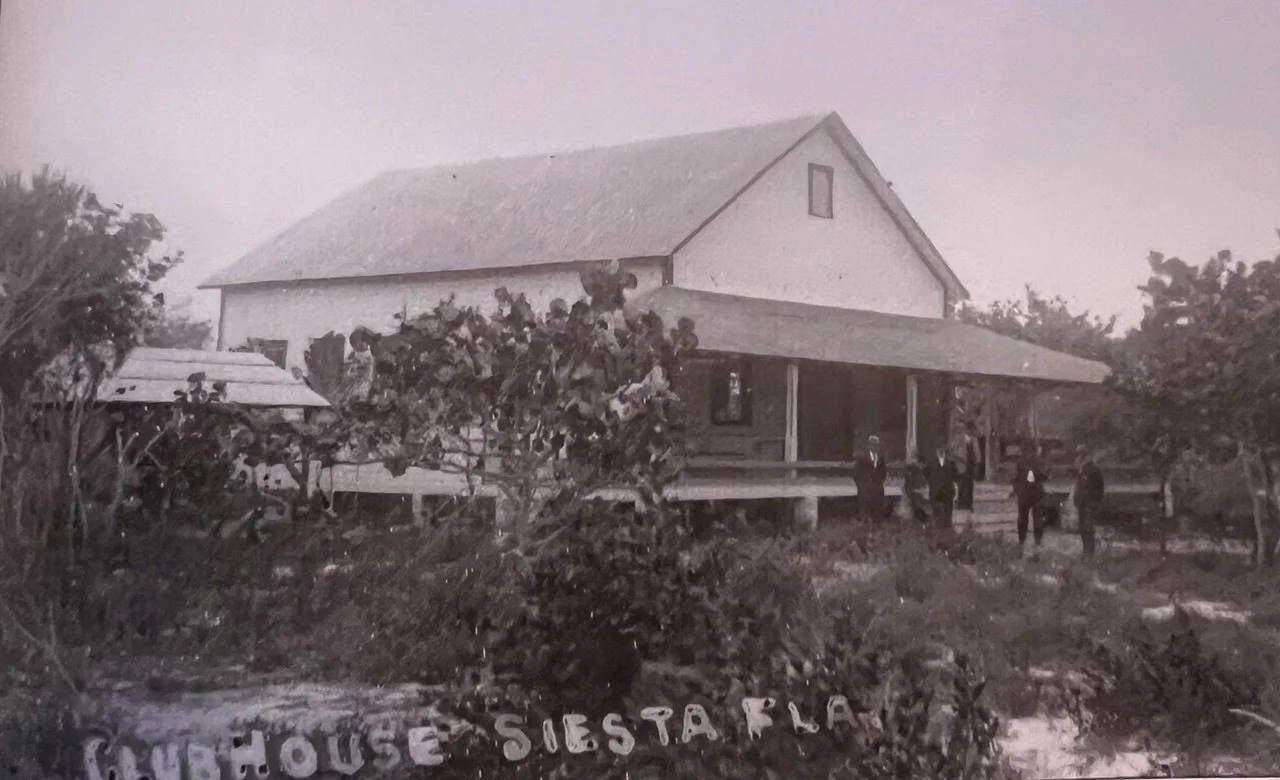
Sarasota Yacht Club circa 1907. Image captured from Images of America: Sarasota by Amy A. Elder
If you've ever turned onto Higel Avenue on your way to the beach, you've driven past a name without perhaps knowing its story. Most people do. They're thinking about parking, about the water, about whether they remembered the sunscreen. But that street name belongs to one of the most extraordinary — and ultimately tragic — figures in Gulf Coast history. A man who looked at a remote, mosquito-ridden barrier island that barely appeared on maps and saw, with complete clarity, what it could become.
His name was Harry Higel. And without him, there might not be a Siesta Key as we know it.
Little Sarasota Key, Before the Dream
To understand what Higel saw, you have to picture what Siesta Key actually was at the turn of the 20th century. It was home to just a few fishing families, with plenty of mosquitoes and snakes to contend with, dense vegetation, wildcats, boars, and sand fleas that made it all but uninhabitable. The island went by several names over the years — Clam Island, Muscle Island, Palm Island, Little Sarasota Key — none of them particularly inviting. The first permanent settlements on the island were founded in the middle of the 19th century, with Captain Louis Roberts constructing the first homestead in the 1870s.
Roberts eventually converted his home into the Roberts Hotel in 1906, and Mrs. Roberts' culinary skills, particularly her clam chowder recipe, gained her a reputation and began to draw A-listers, including Hollywood stars. So even before a bridge existed, before a road, before anything resembling infrastructure — word was already getting out. The Gulf Coast had a way of doing that.
The only way to reach the island was by boat or ferry. For most people, that was the end of the conversation. For Harry Higel, it was the beginning of one.
The Man From Philadelphia
A native of Philadelphia who was born in 1867, Higel came to Venice, Florida with his parents in 1884 and relocated to Sarasota shortly after the town was formed in 1902. Upon his arrival, he purchased the Main Street dock and a store. He was the kind of man who arrived somewhere and immediately started building things — civic institutions, businesses, friendships, a future.
In 1907 he formed the Siesta Land Company with two partners, Captain Louis Roberts and E.M. Arbogast. Together they purchased large tracts of land, dredged bayous, built docks, and platted the northern end of the island — naming it "Siesta on the Gulf of Mexico" and laying out streets, lots, and amenities that shaped the island's layout. It was Higel who gave the island its modern name, choosing "Siesta" deliberately — to evoke rest, peace, the unhurried quality of life that he believed this place could offer to anyone willing to make the crossing.
That same year, he did something equally significant. In 1907 Higel was instrumental in forming the Sarasota Yacht and Gun Club, located on the north end of Siesta Key. Think about what that means for a moment. There was no bridge. There was no road. The island had a population you could count on two hands. And yet Higel planted a yacht club on its northern shore, as if to say: the boats are coming. The people will follow.
A Yacht Club on an Island No One Could Reach
At the time, Siesta Key was considered remote and only accessible by boat. This early iteration of a yacht club in Sarasota was driven by the locally well-known Harry Higel, developer, soon-to-be mayor, and commodore. The club became dormant for a few years — reality occasionally interrupts vision — but Higel wasn't done. In 1913, Harry Higel and friends formed the Sarasota Yacht and Automobile Club on Cedar Point, now known as Golden Gate Point. The land was described as being "made charming by nature, with its evergreen growth of trees and shrubs, the surrounding bay and cool Gulf breezes, with a view for miles."
That description reads like a real estate listing for a dream. And those New Year's Eve celebrations at the club? They were described as "brilliant in the highest, with a hearty informal spirit more like a family or neighbor than might have been expected where guests hailed from half the states in the Union."
That is the Gulf Coast life in one sentence. Brilliant. Informal. Everyone welcome.
The Bridge That Changed Everything
Higel's most lasting practical achievement was the bridge. As Sarasota's mayor, he championed civic improvements, securing voter approval for a 1916 bond that financed the 1,800-foot wooden Siesta Key Bridge, completed in 1917, reducing travel time from hours by boat to minutes by car. Before the bridge, Siesta Key was a place you had to want badly enough to cross the water for. After it, the island opened up to the world.
He also built the Higelhurst Hotel, opened in 1915, and developed Higel Avenue while advocating for dredging and road extensions to attract tourists and residents. He was building an entire world on that island — accommodations, roads, a yacht club, civic infrastructure. All of it pointing toward a future he could see clearly but wouldn't quite live to see completed.
Higel's imposing Higelhurst Hotel, adjoining his bathhouses on the Pass, burned in 1917 just prior to the completion of the first automobile bridge to Siesta. He lost the hotel. The bridge opened anyway. He kept building.
An Unsolved Mystery on the Beach He Loved
In January 1921, Harry Higel went for a walk on his beloved island and never came home. In 1921 he was bludgeoned to death while strolling on Beach Road. His alleged murderer was never punished for the crime, and the poor handling of the murder is said to have played a role in separating Manatee and Sarasota counties, as Sarasota residents were unhappy with the investigation.
He was 53 years old. The second bridge connecting Siesta Drive to Siesta Key was completed in 1927 and dedicated in his honor, but unfortunately he was not alive to see it completed.
The dedication reads simply: "To the Memory of Harry L. Higel. A Beloved Citizen of Sarasota."
It doesn't quite capture it. But then, it never could.
From Yacht Club to Gulf Coast Life
The yachting culture Higel seeded on Siesta Key's northern shore took root and grew far beyond what a single wooden boathouse on Big Pass could have contained. The Sarasota Yacht Club — incorporated in 1926 — is now recognized as a Platinum Club of America and a Platinum Club of the World, with a deep-water marina inside Big Pass offering direct access to Sarasota Bay and a straightforward run to the Gulf of Mexico.
But yachting itself has changed almost beyond recognition from those early days. The club has almost doubled in size since 2010, with a waitlist of new applicants — the largest the club has ever seen. The boats are bigger, the technology is extraordinary, the navigation systems would have seemed like magic to the men who once felt their way across Sarasota Bay by instinct and starlight.
What hasn't changed is the reason people come. "You join a yacht club for the magic," as one member put it simply. The magic of the water. The magic of the Gulf at dusk. The magic of a community of people who understand, collectively, that this particular stretch of coastline is something genuinely worth protecting, worth celebrating, worth rearranging your life to be close to.
Harry Higel understood that in 1907 when there was nothing here but sand and possibility. It's why he named it Siesta. It's why he built a yacht club before there was a road to reach it.
He was building the life first. Everything else would follow.
The Thread That Runs Through It
When we drive through Sarasota looking for the next beautiful piece of furniture to find its new home, we sometimes think about the people who lived in this place before the bridges, before the condos, before the rankings and the awards and the million-dollar beach houses. The ones who looked at this Gulf Coast and saw something worth staying for.
The furniture we find — the Tommy Bahama bedroom sets, the dining tables, the pieces that have lived in Gulf Coast homes for decades — carries something of that same spirit. Things made for a life lived with intention, on a coast that has always rewarded the people brave enough to make the crossing.
Higel Avenue is still there. Drive down it slowly sometime. Think about the man it's named for, and what he saw when he looked at this island that nobody else could reach.
He wasn't wrong.
